Agents
- Language model with tools and context
- Memory can be provided as a tool
- In chat-driven paradigm, model must decide when to use tools
- Must select from all available tools at a time
- Limited context window on smaller models can cause confusion
- Workflow paradigm allows us to restrict tools and process results
- Can orchestrate multiple agents on subtasks
Profiles & Roles
| A | B |
|---|---|
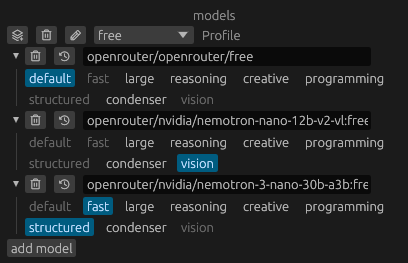 | 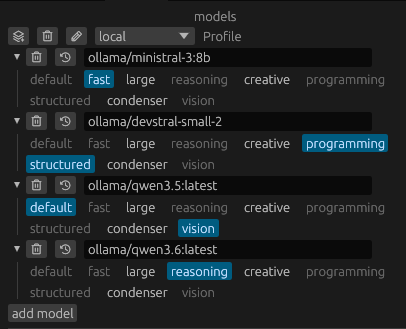 |
Profiles are sets of models tagged with pre-defined roles. Within a profile, each model can have multiple roles. However, each role can be assigned to at most one model.
Profiles are user defined and the meaning of each is left for you to decide. On the other hand, there are a fixed set of roles: reasoning, creative, programming, etc. An agent can fill one of a fixed set of roles based on how it will be used in the workflow.
These roles determine which model from the profile that the agent will use. If
a model works well on creative and reasoning tasks but has trouble generating
structured output, you can tag a different model with the structured role.
Together they provide a layer of abstraction that allows you to switch between local vs remote providers during workflow authoring, for example. Then during batch execution, you can supply a production profile. Alternatively, you can compare how well a workflow runs with Anthropic and OpenAI models by defining profiles for each without changing the workflow itself.
If a model is tagged with the default role it will be used in place of any role that is not assigned to a model. For instance, if no model is tagged with creative, when a creative agent runs, it will use the default model instead. If no model is tagged with default, then the workflow will fail.