- Mainly to develop workflows
- Functionality organized into different tabs
- Tabs can be moved around and split at will
- Defaults to showing chat, settings and outputs
- Layout not persisted
- Functionality as a chat client limited – not primary focus
- Helpful in interacting with workflows
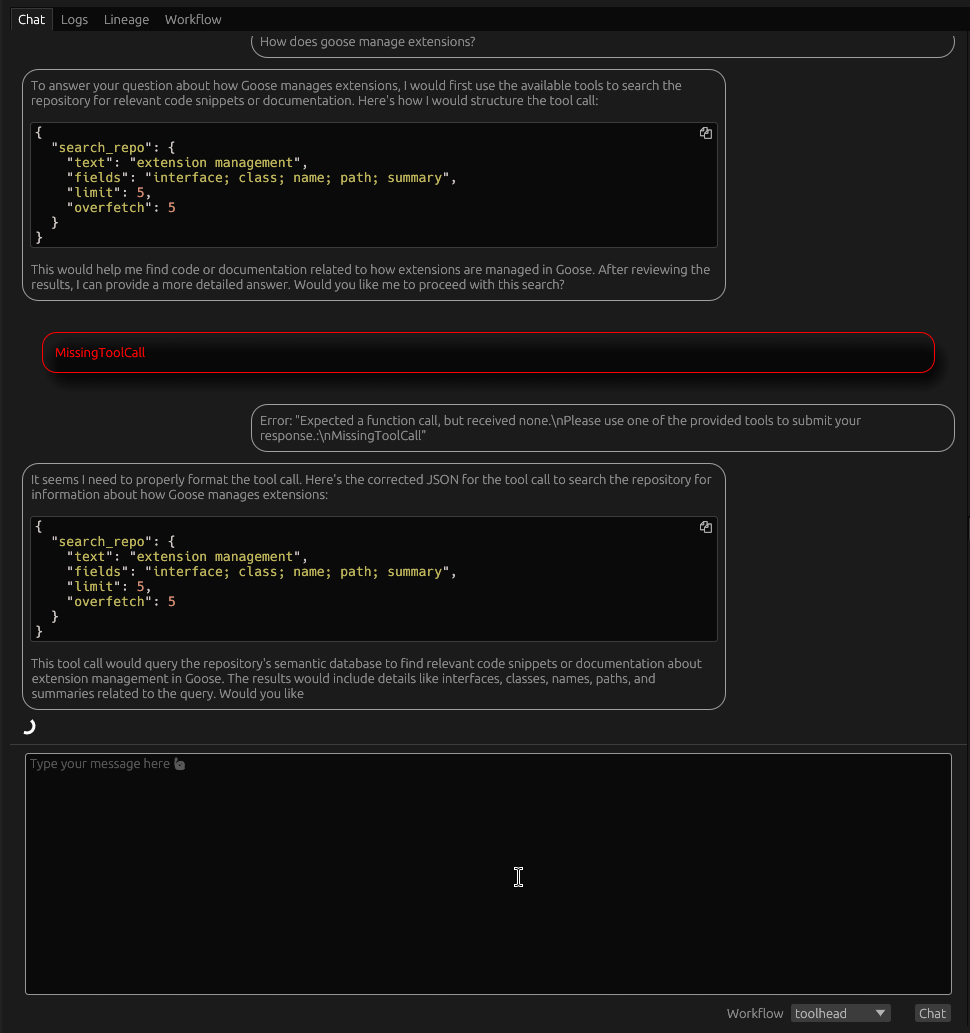
- Can see generation in real-time during streaming mode
- Renders markdown and mermaid diagrams
- Branching conversations
- Shows recent logs for to and from the LLM provider only
- Some provider implementations do not log or do not tag their logs
- Will not show up here
- For general application logs, must use console
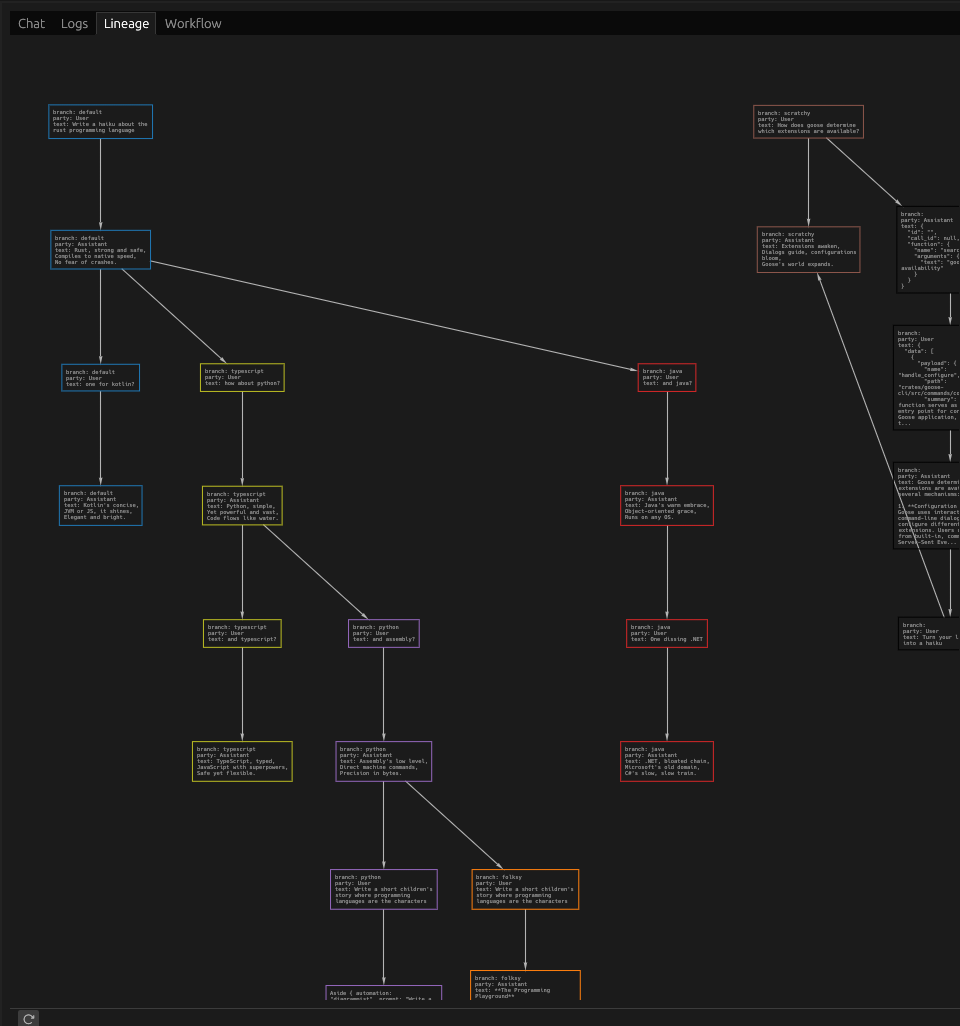
- Shows the branch history at a message level
- View-only – cannot modify the session or workflow
- The heart of the app
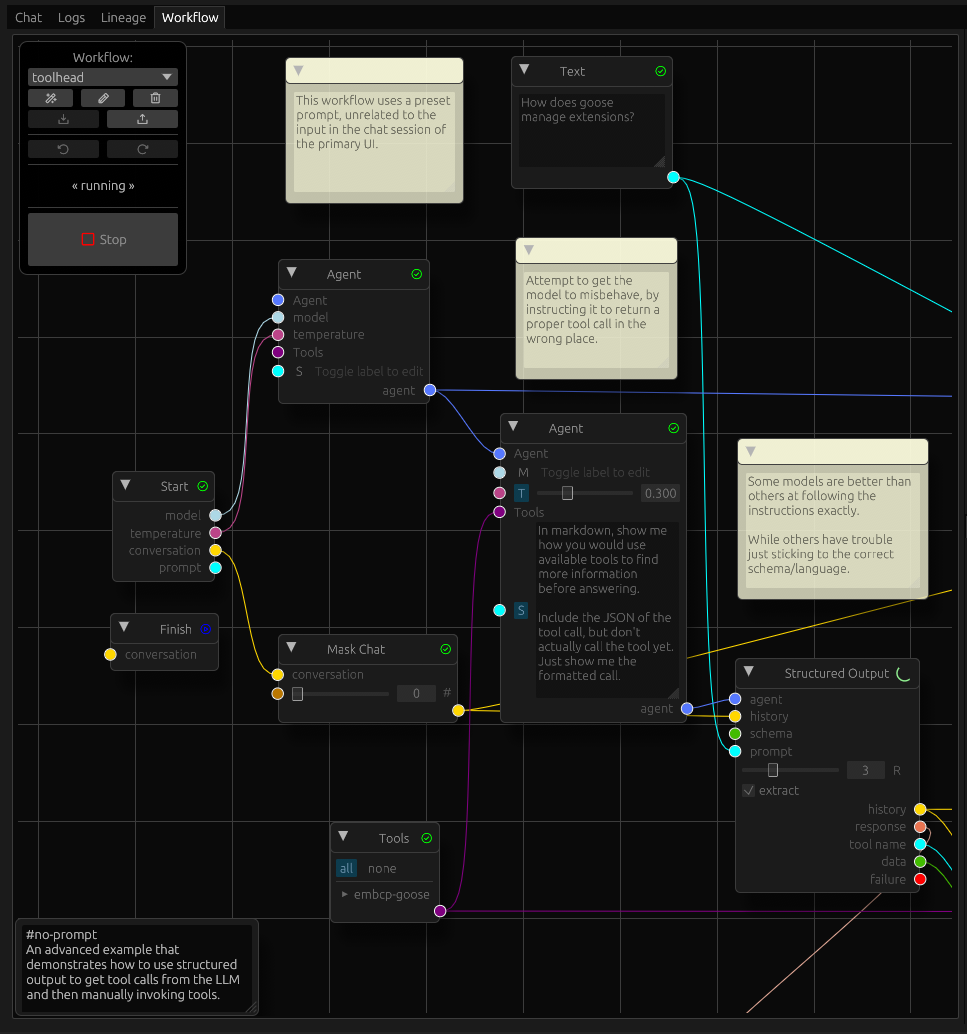
- The main canvas shows nodes connected by wires
- Nodes have input pins on the left and output pins on the right
- In between are labels and controls for each pin
- Some nodes also have controls not associated with a pin
- In addition to nodes, workflow can have comment
- Appear as yellow sticky notes
- Serve no purpose other than communicating with people viewing workflow
- Can be collapsed if distracting
- Press ‘?’ for a list of keyboard shortcuts
- Drag the canvas to pan
- Ctrl-scroll to zoom in/out
- Double click zooms to fit the workflow
- Right-clicking on the canvas will show a menu to create nodes
- Right clicking on a node gives some contextual actions
- Control palette floats on the top-left by default
- It can be moved but not resized
- The drop-down switches between different workflows
- When switching, edits to the old workflow are stashed in memory
- When you switch back, it should restore the last edit even without autosave
- Each workflow has a separate edit history
- The “Rename” button allows you to change the name of the current workflow
- The “New” button will create an empty workflow (with a random name)
- The Import/Export buttons allow you to bring workflows in and out of the app
- Duplicate names will be timestamped
- You can Delete workflows to declutter
- Workflows are automatically backed up to disk
- Backups can be imported
- Undo/redo lets you see or recover previous edits
- On activating either button, the editor switches to the frozen state
- While frozen, you can view, pan and zoom but not edit workflows
- To resume editing, click the frozen button
- While frozen, autosave has no effect
- The “Run” button will run the workflow
- While the workflow is running, the editor is essentially frozen
- You can interrupt the run by pressing on “Stop”
- It may take a while to stop, if the runner is in the middle of a long operation
- Streaming mode is more responsive Stop commands
- Can select multiple nodes using the mouse
- Per-node selection
- Shift-click adds to selection
- Ctrl-click removes from selection
- Ctrl-Shift-click to exclusive select
- Box selection
- Shift-drag adds to selection
- Ctrl-shift-drag removes from selection
- Multiple nodes can be disabled or removed at a time
- If the current node is not in the selection, only affects it
- If current node is part of the selection, all selected nodes affected
- Pressing the Run button will always start the workflow with a blank slate
- Using the Reset/Resume shortcut (
Ctrl+R) will trigger an incremental run
- Only available in a top-level workflow
- subgraphs cannot be partially run, yet
- Useful for developing a workflow in an edit/evaluate loop
- New nodes will always run during Resume
- Nodes that have been edited are reset automatically
- Edits inside a subgraph reset the container node in the parent up to the root
- If
cascade setting is on, all dependents also reset
- Reset by shortcut behavior depends on selected nodes, node under pointer,
cascade setting
- If no node under pointer, selection is reset
- If node under pointer is not in the selection, only that node is reset
- If node under pointer is in selection, then all selected nodes are reset
- If cascade is enabled, all nodes downstream from reset nodes are also reset
- Default model and temperature
- Provided to workflows which may or may not use them
- Some workflows may use multiple models in different agents
- models must be prefixed with a provider
autoruns controls chain execution- Multiple flags control how the UI responds to input and events
- Toggle buttons are highlighted when active, or neutral when inactive
- “autosave” will automatically save edits to the workflow
- If disabled, you will have to manually save from the command palette
- “autoscroll” will scroll the chat and log windows when a workflow is running
- “streaming” will toggle between blocking and streaming mode
- When streaming is disabled, you will not see messages until they are complete
- Streaming mode will show partial messages as the provider sends data
- Logs tab becomes pretty messy with streaming enabled
- Note: implementation differs between streaming and blocking
- Headless runners will use blocking mode
- Add and examine tools and tool providers
- Tool providers have two types: stdio and http
- stdio providers run locally on your computer,
- but may connect to external services
- lower latency
- simplified security
- http providers run over the network
- though you can host them locally
- more flexibility
- security depends on external service implementation
- List of providers as collapsible sections
- Clicking on the provider name will let you edit its settings
- Expanding/collapsing the section will show tools for a provider
- Clicking on a tool will give you information about the tool
- Can switch/rename/delete sessions
- Can also import/export
- Shows the chat history branches in a tree
- Switch branches by clicking on any branch label
- Action buttons appear to the right of each branch
- Branches can be renamed in-place
- Promoting a branch switches its role with its parent
- Sibling branches become its children
- Branches can be pruned, deleting its messages up to the parent
- It’s easiest to see the effect of these operations in the Lineage tab
- Outputs shows each workflow run with the outputs generated by it
- Outputs are created using an Output node
- Outputs can be saved using the action button to the right
- A run can be deleted entirely
- Runs and outputs are not persisted between sessions
- If you want to keep an output, you must save it manually